Understanding the various types of reactive dyes is fundamental for any textile professional or chemical engineer aiming to achieve vibrant, long-lasting colors on cellulosic fibers. Unlike traditional dyes that merely sit on the surface of a fabric, reactive dyes create a covalent bond with the fiber molecule, ensuring superior wash-fastness and brilliance that withstands the rigors of daily wear and industrial laundering.
Globally, the demand for high-performance coloring agents has surged as the fashion and home textile industries shift toward sustainable, high-quality production. The ability to select the correct dye based on the fiber type, desired shade, and environmental constraints allows manufacturers to reduce waste and energy consumption, making the mastery of these chemical agents a cornerstone of modern sustainable manufacturing.
In this comprehensive guide, we will explore the chemical distinctions between different types of reactive dyes, from vinyl sulfone to triazine systems. By aligning these chemical properties with the right auxiliaries, such as CMC or HPMC, producers can optimize their printing pastes and dyeing cycles for maximum efficiency and color yield.
Global Industry Context of Reactive Dyes
The global textile chemical market has undergone a massive transformation, with types of reactive dyes becoming the dominant choice for cotton, viscose, and linen. According to industry reports aligned with ISO quality standards, the move toward "right-first-time" dyeing has forced manufacturers to move away from simple pigmenting to the precise molecular bonding offered by reactive systems.
However, the industry faces a significant challenge: the high volume of salt and alkali required for fixation. This has led to an urgent global search for "low-salt" or "cold-pad-batch" dye types that maintain the same color depth while reducing the environmental footprint, especially in regions with strict wastewater regulations like the EU and North America.
Defining the Chemistry of Reactive Dyes
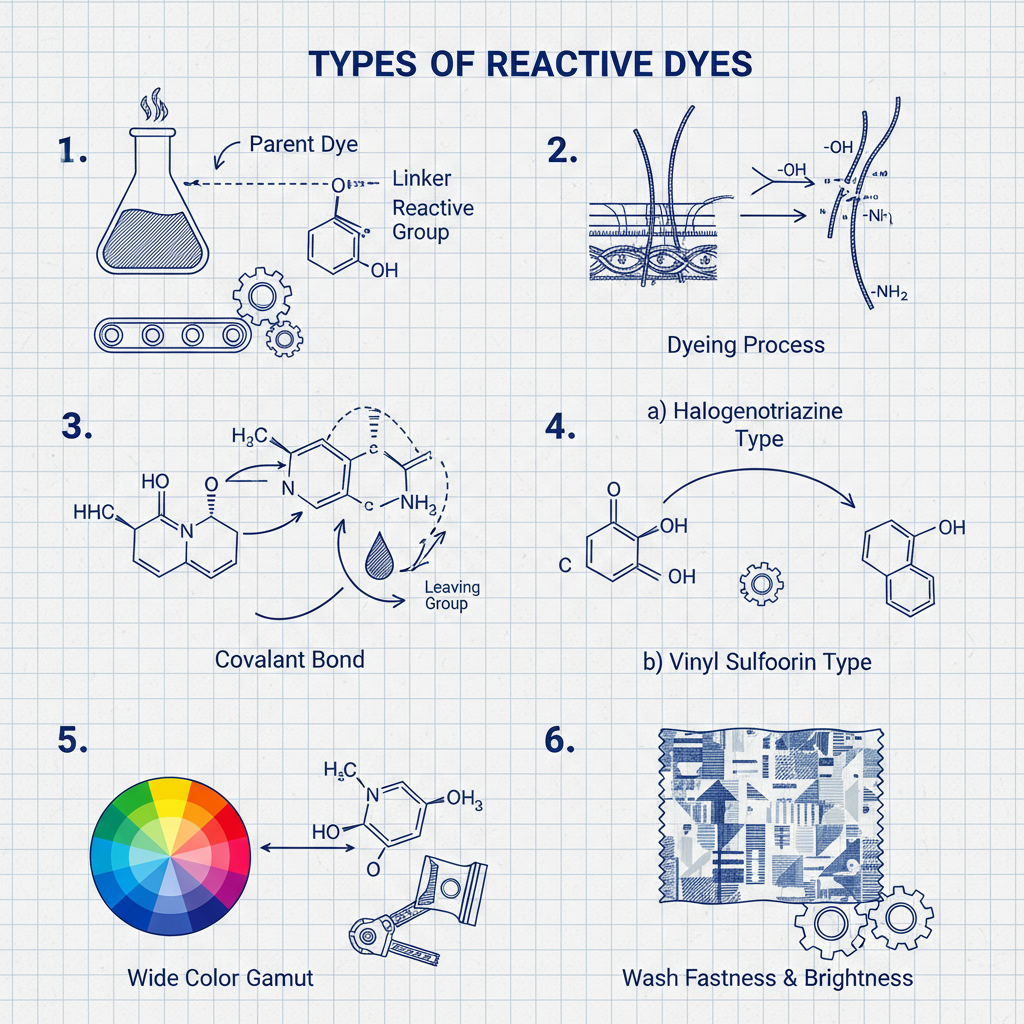
At its core, a reactive dye is a chemical compound containing a chromophore (the color-producing part) and a reactive group. This reactive group is designed to undergo a chemical reaction with the hydroxyl (-OH) groups of cellulose. Unlike direct dyes, which rely on physical attraction, these dyes form a covalent bond, meaning the dye actually becomes a part of the fiber's molecular structure.
Modern industrial chemistry classifies these into several categories based on their reactive groups. For instance, Monochlorotriazine (MCT) dyes are known for their versatility, while Vinyl Sulfone (VS) dyes are prized for their exceptional brilliance and stability. Understanding these types of reactive dyes is essential for ensuring that the chosen chemistry matches the temperature and pH requirements of the production line.
This molecular bond is what makes reactive dyes indispensable for high-end apparel and home textiles. By integrating these with high-quality thickeners like CMC (Carboxymethyl Cellulose) or HPMC, manufacturers can control the viscosity and penetration of the dye, preventing "bleeding" and ensuring a sharp, professional finish on the fabric.
Key Factors Influencing Dye Selection
The first critical factor when evaluating types of reactive dyes is the Fixation Rate. A higher fixation rate means more dye bonds to the fabric and less is washed away into the wastewater, which directly impacts both cost efficiency and environmental compliance.
Secondly, the application temperature is a deciding factor. Cold-brand dyes allow for energy-saving processes, while hot-brand dyes offer deeper shades and better penetration for heavy-duty fabrics. Selecting the wrong temperature profile for specific types of reactive dyes can lead to uneven coloring or "spotting" on the material.
Finally, the compatibility with auxiliaries cannot be overlooked. Whether using RDP-VAE for stability or PVA for binder properties, the interaction between the dye and the chemical additives determines the final hand-feel and durability of the textile, ensuring the product meets international quality benchmarks.
Global Applications and Industrial Use Cases
The application of different types of reactive dyes varies significantly by region. In Southeast Asian hubs, where fast-fashion production is concentrated, high-exhaustion dyes are preferred to maximize throughput and minimize water usage. Meanwhile, in the luxury textile markets of Italy and France, specialty reactive dyes are used to create intricate prints with ultra-high color precision.
In practical industrial zones, these dyes are often paired with specialized printing pastes. For example, a combination of CMC Printing Paste and reactive dyes is frequently used in the production of high-grade cotton bedding and towels, where the paste prevents the dye from spreading, maintaining the integrity of the design across thousands of linear meters of fabric.
Performance Comparison of Different Types of Reactive Dyes
Advantages and Long-Term Commercial Value
The primary commercial advantage of utilizing various types of reactive dyes is the unmatched wash-fastness. Because the dye is chemically bonded to the fiber, the colors do not fade easily, which increases the lifecycle of the garment. This longevity is a key selling point for brands focusing on "slow fashion" and durability, providing consumers with a sense of quality and value.
Furthermore, from a manufacturing perspective, the ability to achieve a vast spectrum of colors with high reproducibility ensures consistency across different batches. When paired with stabilizers like HPS (Hydroxypropyl Starch Ether), these dyes provide a reliable production flow, reducing the rate of rejected fabrics and enhancing the overall profitability of the mill.
Future Trends in Sustainable Dyeing Technology
The future of types of reactive dyes is moving rapidly toward "green chemistry." Innovation is currently focused on developing bio-based reactive groups that eliminate the need for heavy salts during the fixation process. This digital transformation in chemical formulation allows for precise dosing, reducing water pollution and aligning with the UN Sustainable Development Goals.
Automation and AI-driven color matching are also reshaping how these dyes are applied. By using sensors to monitor the pH and temperature in real-time, factories can automatically adjust the addition of auxiliaries like HEC (Hydroxy Ethyl Cellulose) to ensure that the reactive dye bonds perfectly without wasting chemical resources.
Moreover, the integration of nanotechnology is enabling "intelligent dyes" that can respond to external stimuli. While still in the experimental phase, these next-generation types of reactive dyes could potentially change color based on temperature or UV exposure, opening new doors for functional textiles in the medical and military sectors.
Common Challenges and Technical Solutions
One of the most persistent challenges with types of reactive dyes is the issue of hydrolyzed dye. Hydrolysis occurs when the dye reacts with water instead of the fiber, resulting in "wasted" dye that must be washed off. This not only increases chemical costs but also creates a significant environmental burden in the effluent stream.
To overcome this, experts suggest the use of high-performance thickeners and precise alkali dosing. By utilizing a controlled-release system through the use of MHEC (Hydroxyethyl Methyl Cellulose), the dye is held in a stable matrix, ensuring that the reaction occurs primarily at the fiber interface rather than in the bulk liquid.
Another challenge is the "leveling" of the dye on blended fabrics. To solve this, the industry is adopting a multi-stage dyeing approach where different types of reactive dyes are used in sequence, each targeting a specific fiber component, ensuring a uniform, streak-free appearance across the entire textile.
Technical Analysis and Comparison of Reactive Dye Systems
| Dye Classification |
Fixation Temp (°C) |
Wash Fastness |
Eco-Impact Score |
| Vinyl Sulfone (VS) |
60 - 80 |
Excellent |
7/10 |
| Monochlorotriazine (MCT) |
40 - 60 |
Good |
6/10 |
| Bifunctional Reactive |
40 - 80 |
Superior |
9/10 |
| Cold-Brand Reactive |
20 - 30 |
Fair |
8/10 |
| High-Fixation (LF) |
60 - 90 |
Excellent |
9/10 |
| Low-Salt Reactive |
40 - 70 |
Good |
10/10 |
FAQS
The primary categories include Vinyl Sulfone (VS) dyes, which are known for brilliance and stability; Monochlorotriazine (MCT) dyes, which are versatile and applied at lower temperatures; and Bifunctional dyes, which combine two reactive groups to increase the fixation rate and reduce wastewater pollution. Each type is selected based on the fiber substrate and the desired wash-fastness properties.
Unlike direct dyes, which are held to the fiber by weak physical forces (Van der Waals), reactive dyes form a permanent covalent bond with the cellulose molecule. This means the dye becomes an integral part of the fiber, resulting in significantly higher wash-fastness and resistance to fading, making them the gold standard for high-quality cotton apparel.
Generally, no. Reactive dyes are specifically designed for cellulosic fibers (cotton, linen, rayon) that have hydroxyl groups. For polyester, disperse dyes are used. However, for blended fabrics (e.g., poly-cotton), a dual-dyeing process is employed where the polyester is dyed with disperse dyes and the cotton is dyed with reactive dyes to achieve a uniform color.
Thickeners such as Carboxymethyl Cellulose (CMC) and Hydroxypropyl Methyl Cellulose (HPMC) are crucial for maintaining the viscosity of the dye paste. They prevent the dye from spreading or "wicking" into unwanted areas of the fabric, ensuring sharp design edges and uniform color distribution, which is especially critical in the textile printing process.
Traditionally, they required large amounts of salt and alkali, which impacted water quality. However, modern innovation has led to "low-salt" and "high-fixation" types of reactive dyes. These new formulations significantly reduce the amount of unreacted dye and salts released into the effluent, making the process much more sustainable and compliant with global environmental standards.
Spotting is usually caused by uneven alkali distribution or poor dye solubility. To prevent this, ensure the fabric is thoroughly pre-treated (scoured), use a high-quality stabilizer like PVA or HEC to ensure a smooth paste, and implement a gradual alkali dosing strategy to allow the dye to level out before the fixation reaction begins.
Conclusion
Mastering the various types of reactive dyes is more than just a technical requirement; it is a strategic advantage for any textile manufacturer. By understanding the chemistry of covalent bonding and the nuances between VS, MCT, and bifunctional systems, producers can guarantee superior color brilliance and unmatched durability. The synergy between these dyes and high-performance auxiliaries like CMC and HPMC remains the key to achieving a professional, high-value finished product.
Looking forward, the industry must continue to embrace the shift toward green chemistry and automated precision. As environmental regulations tighten and consumer demand for sustainable fashion grows, the transition to low-salt, high-fixation reactive systems will define the leaders of the next industrial era. We encourage manufacturers to invest in these sustainable technologies today to ensure long-term viability and ecological responsibility. Visit our website for more professional chemical solutions: www.pezetech.com